
Field Notes · August 22, 2026 · 6 min read
Quartz vs. Granite Countertops: Cost, Care and How to Choose
Quartz vs granite for your kitchen: 2026 installed costs, maintenance, durability, the silicosis question answered honestly, and which to pick.
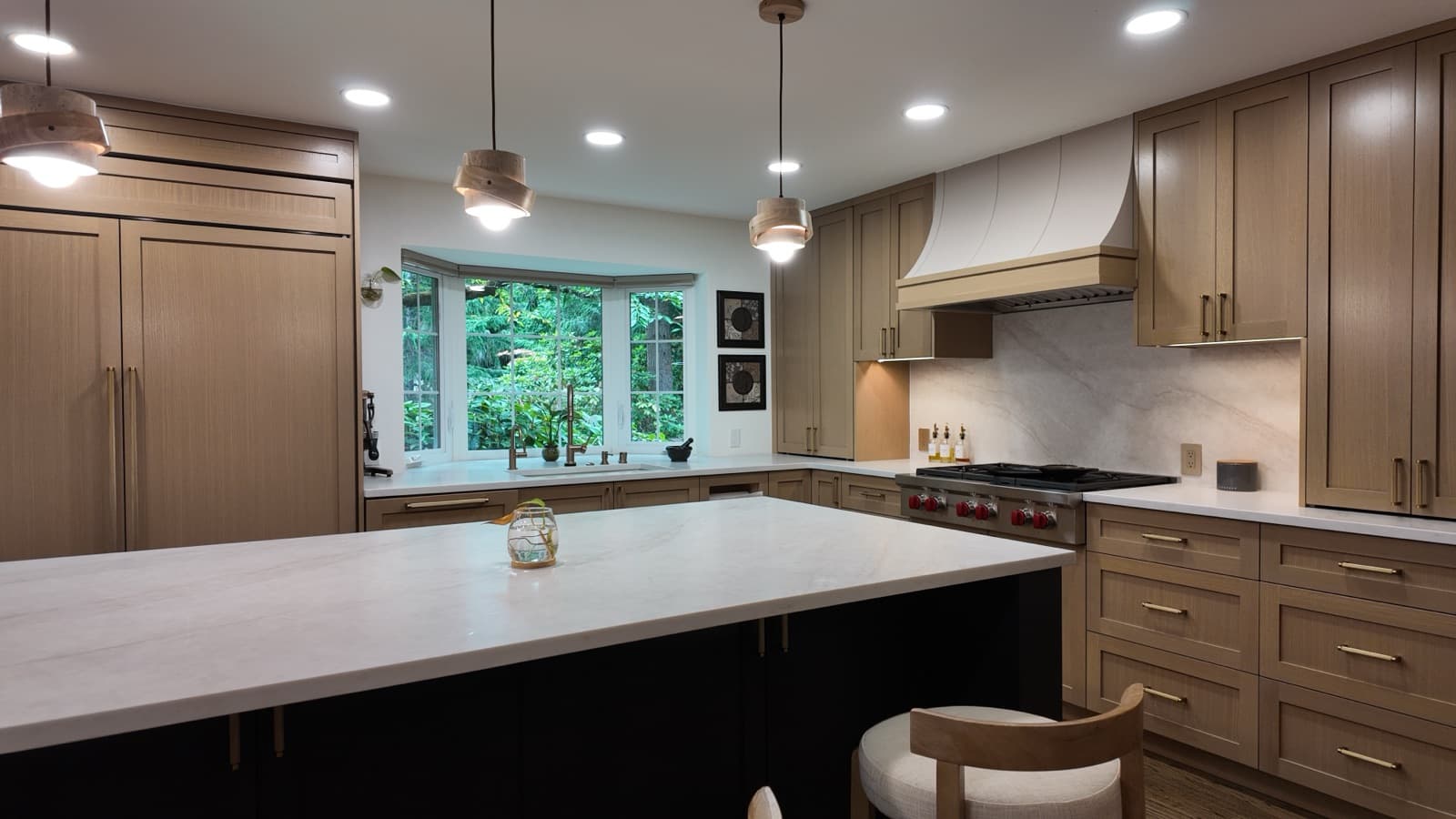
“Granite or quartz” is rising again in Washington searches, along with two very different follow-ups: how to clean quartz, and whether it’s safe. Here are the straight answers on all three — cost, care, and the silica question — from a crew that installs both every month.
The five-minute decision guide
- Quartz ($70–$150/sq ft installed). Engineered stone: ground quartz in resin. Consistent pattern across every slab, non-porous so it never needs sealing, cleans with dish soap. The default choice in most of our kitchens — including the continuous quartz surfaces in our Bellevue White Oak Kitchen.
- Granite ($50–$120/sq ft). Real quarried stone: every slab unique, slightly better with direct heat, often cheaper at the entry level. The trade: it’s porous, so it needs sealing on a recurring schedule, and the slab you saw in the yard is the slab you must love.
For a typical kitchen, counters land roughly $3,500–$8,000 installed either way — waterfall ends, slab backsplashes and sink cutouts are what push the top end. In the whole-kitchen budget, counters run well behind cabinets; the kitchen cost guide shows the full picture.
Care, honestly
Quartz: warm water, mild dish soap, soft cloth — daily, done. Skip abrasive powders, bleach and oven cleaner, which attack the resin, and use a trivet under hot pans. Granite: same gentle cleaning, plus the sealing schedule — a simple water-drop test (if it darkens the stone, reseal) keeps you ahead of stains. Neither wants to be a cutting board; that’s what ruins edges and knives alike.
The silica question, answered straight
The headlines about silicosis and engineered stone are real — and they’re about fabrication workers, not homeowners. Cutting engineered stone dry releases fine silica dust; done repeatedly without protection, it causes serious lung disease. An installed, finished counter in your kitchen sheds no dust and poses no such risk. Where this matters for you is supplier choice: responsible fabrication shops cut wet, ventilate and protect their people. We buy from shops that do — it’s the same principle as everything else in construction: the invisible standards are the ones that count.
How to choose in practice
Want zero maintenance and a consistent look across a big island? Quartz. Love natural variation and want entry pricing? Granite, sealed on schedule. Either way, choose the slab before demo — counter lead times are one of the three delays in the kitchen timeline guide, and templating can only happen after cabinets are set.
See slabs with a builder, not a salesperson
The free estimate includes the counter conversation — what your layout needs, what each material runs for your square footage, and which fabricators we trust with the cut.
Frequently asked questions
- Which is better, quartz or granite?
- Quartz for consistency and zero maintenance — no sealing, uniform pattern, easy care — which is why it's now the default in most remodels. Granite for natural one-of-a-kind stone and slightly better heat tolerance, at the cost of periodic sealing. Neither is wrong; the maintenance difference is the honest tiebreaker.
- How much do quartz countertops cost installed?
- In the Seattle area in 2026, quartz typically runs $70–$150 per square foot installed depending on brand and pattern; granite runs $50–$120. A typical kitchen's counters land roughly $3,500–$8,000 total, with waterfall edges, full-height slab backsplashes and complex cutouts pushing higher.
- What should I clean quartz countertops with?
- Mild dish soap, warm water, a soft cloth — that's it, daily. Avoid abrasive powders, bleach and high-pH cleaners, which can dull the resin, and don't put hot pans directly on quartz; use a trivet. The no-sealing, soap-and-water routine is most of why people choose it.
- Are quartz countertops safe? What about silicosis?
- Installed quartz counters pose no silica risk in your home — the hazard in the news is occupational: workers cutting engineered stone dry without protection inhale silica dust during fabrication. It matters when choosing who makes your counters: reputable fabricators use wet-cutting and dust controls, and that's the standard we hold our suppliers to.
Written by
Eduard — Owner & General Contractor
Eduard owns ENF General Contractors and has built and remodeled homes across Everett, Seattle & the Eastside for more than fifteen years. Licensed, Bonded & Insured. He runs every ENF project personally — and writes these guides from the job site. More about Eduard · (425) 217-9921