
Field Notes · October 12, 2026 · 7 min read
Does My Siding Need Replacing? Signs, Repair vs. Re-Side, and Timing
How to tell whether Puget Sound siding needs replacing or repairing: the signs that matter, why hardboard fails here, and what each option costs.
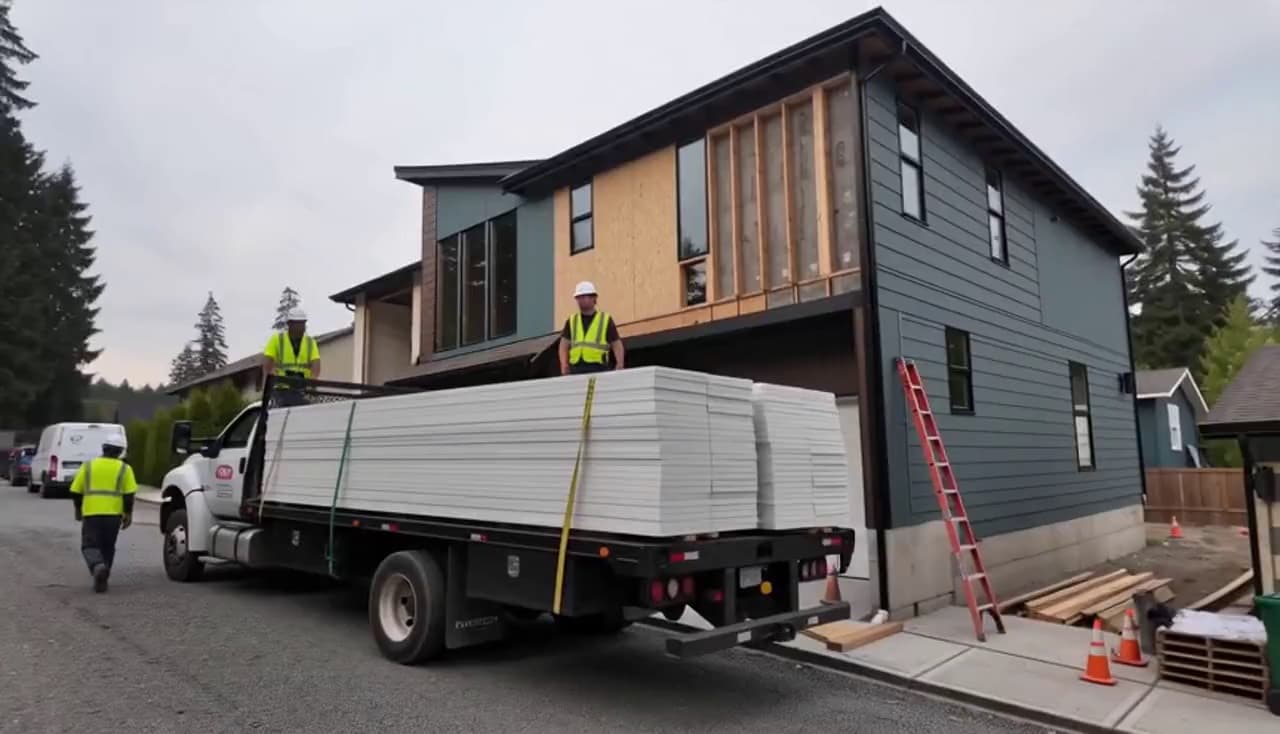
Siding in this climate rarely wears out. It fails — and the failure is almost always water getting behind it and having nowhere to go. That shapes everything about how to read a wall.
Here is how we tell a wall that needs a repair from one that needs a re-side, and what each actually costs.
The signs that matter
- Swelling at the bottom course. The lowest foot of wall takes splash, grade moisture and gutter overflow. On hardboard and older composite it thickens and softens here first.
- Boards separating at the seams. Gaps opening at butt joints and corners mean the material has moved or shrunk. Caulk will not hold it.
- Vertical staining or lifted paint under gutter joints. That is an overflow line, and the siding under it has been wet every winter. The gutter damage guide covers why.
- Soft spots. Press a thumb at the bottom edge, beside downspouts and around the deck ledger. Give means rot.
- Daylight, draughts or pests at corners and trim. The envelope is open.
Faded colour, chalking and a tired finish are not on that list. They are a paint question, and the painting guide covers when a repaint is the right purchase and when it is a delay.
What is failing decides what to do
Hardboard and 80s–90s composite fail from water at cut edges and bottom courses, and once one elevation has gone the rest is usually close behind. Patching sound-looking sections beside failed ones tends to buy two or three years. That is the stock through much of Bothell, Lynnwood and the 70s–90s hillside neighbourhoods, and it is why we are candid that a repair there is often a deposit on a re-side.
Fiber cement from the same era usually holds as a material. What fails around it is the original paint, caulk and flashing — and those are repairable without replacing the wall.
Cedar depends entirely on how it has been kept. Maintained cedar lasts decades; cedar left grey and bare on a weather-facing wall cups and splits, and localised replacement of the worst boards is routine.
Repair or re-side?
The honest test is pattern. One failed elevation on a house whose other three walls are sound, or a run under a gutter that has been overflowing, is a repair. The same product swelling at the base on every elevation is a material at the end of its life, and repair is money spent on a countdown.
- Repair and partial replacement: $3,000–$15,000, including the flashing correction that caused it
- Full re-side: $12–$22 per square foot in fiber cement or engineered wood — roughly $25,000–$50,000 on a 2,000 square foot house
The siding cost guide breaks those numbers down by housing stock, and the cladding comparison covers what to put back on.
What the tear-off finds
You cannot see the sheathing until the cladding is off, which is why an honest siding quote carries a rot allowance and an hourly rate above it rather than one optimistic number. What we find is predictable: damage at the bottom course, around deck ledgers, and at window heads that were never flashed because the standard of the day did not require it. On exposed west-facing walls through Edmonds and Mukilteo there is more of it.
None of that is a reason to delay. It is a reason to budget for it and to pick a contractor who shows you what they found before they repair it.
Why the rain screen matters more than the product
If you do re-side, the single most valuable thing on the wall is the air gap behind the cladding. It lets water that gets past the siding drain and lets the assembly dry. In a climate with eight wet months, that detail does more for the wall’s life than the choice between fiber cement and engineered wood — and it is the thing to look for when you compare bids.
When to do it
Walls open in the dry season: late spring through September, so the new weather barrier goes on dry. That means deciding over winter. A failing wall will survive one more wet season if it has to — it will not get cheaper. The October exterior checklist is the walk-around to do now.
Get an honest read on the wall
We re-side and repair across Snohomish and King County, and the free estimate will say plainly whether you are looking at a repair, a re-side, or a paint job — including when the answer is “not yet.”
Frequently asked questions
- How do I know if my siding needs replacing?
- Look at the bottom course and under every gutter joint. Swelling, boards separating at the seams, paint lifting in vertical stripes, soft spots you can press a thumb into, and daylight or draughts at the corners are the signs that matter. Faded colour and chalking are cosmetic; those five are not.
- Can siding be repaired instead of replaced?
- Often, when the failure is localised — one elevation, a run under a failed gutter, the band around a deck ledger. Repair runs roughly $3,000–$15,000. It stops making sense when the same product is failing in several places at once, because you are paying to patch a material that is reaching the end of its life everywhere.
- Why does hardboard siding fail so badly here?
- It absorbs water at cut edges and bottom courses, swells, and then delaminates — and thirty wet Northwest winters is exactly the dose that finishes it. Early-generation composite from the 80s and 90s behaves the same way. Fiber cement from the same era usually holds, though its original paint and flashing are often past their service life.
- When is the best time to replace siding in Western Washington?
- Late spring through September, so the wall is open in dry weather and the new weather barrier goes on dry. That means deciding over winter and booking early. A failing wall will survive one more wet season if it must; it will not get cheaper doing so.
Written by
Eduard — Owner & General Contractor
Eduard owns ENF General Contractors and has built and remodeled homes across Everett, Seattle & the Eastside for more than fifteen years. Licensed, Bonded & Insured. He runs every ENF project personally — and writes these guides from the job site. More about Eduard · (425) 217-9921